Buyer Guides
The V5C Is Not Proof of Ownership: The Most Misunderstood Document in Motoring
Printed on every V5C, in the DVLA's own ink, is a warning almost nobody reads: this document is not proof of ownership. It names the keeper — the person who taxes it and fields the speeding tickets — not the owner. And the gap between those two jobs is exactly where finance companies, lease firms and car thieves live. Here's how to use the most misunderstood piece of paper in Britain properly.

Ricki Angel
Founder, BuyCarCheck · 14 July 2026 · 7 min read
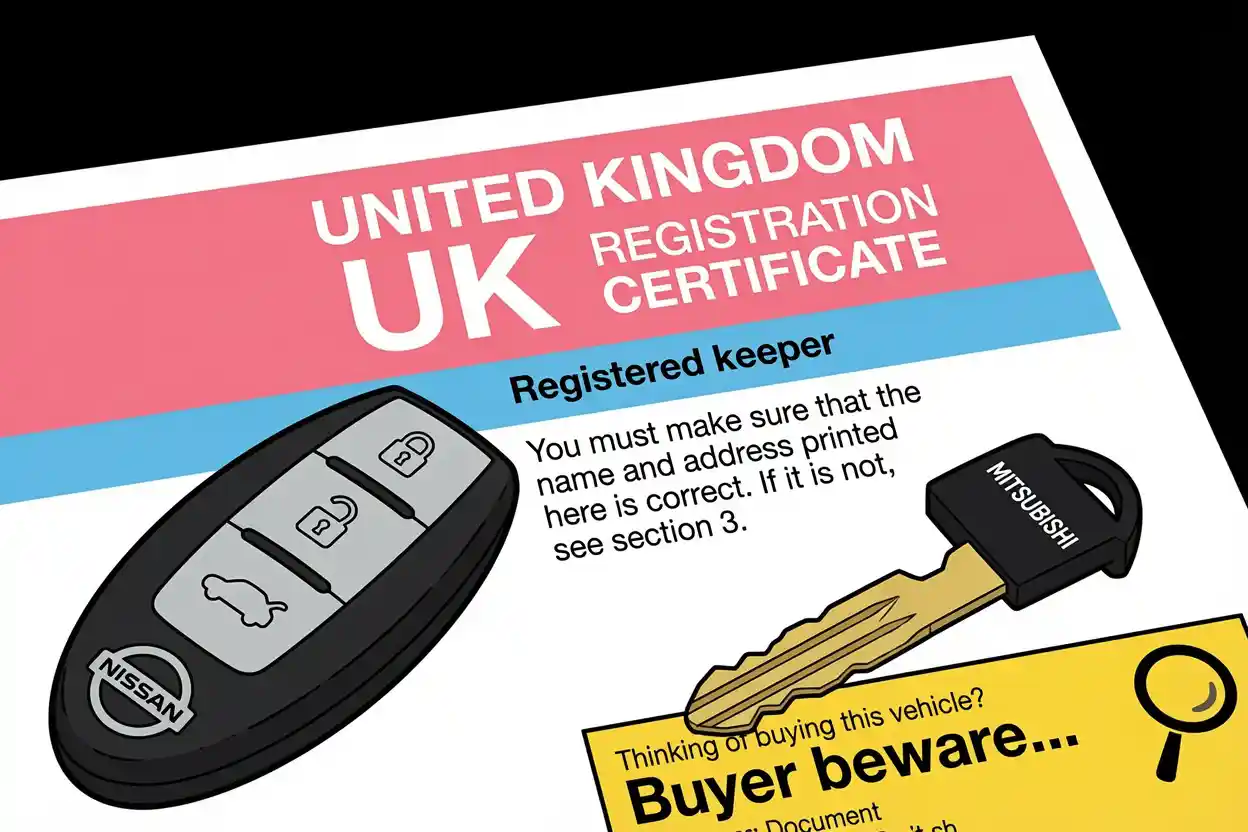
Here's a fact that surprises almost everyone: printed on the V5C — the famous “logbook”, the document buyers demand, sellers brandish, and half the country believes is a title deed — are words to this effect, in the DVLA's own ink: “This document is not proof of ownership.”
It's right there. On the document. And yet “he had the logbook, so it must be his car” is probably the single most expensive assumption in British motoring. So let's take apart the most misunderstood piece of paper in the country: what the V5C actually is, what it absolutely is not, and how the gap between the two is exactly where scammers live.
Keeper and owner are two different jobs
The V5C records the registered keeper — the person responsible for the car day to day: taxing it, insuring it, fielding the speeding tickets. The owner is whoever actually holds title to the metal — the person or company that paid for it. Usually that's the same human. But “usually” is doing an enormous amount of work in that sentence:
The company car
The employee is the keeper; the company (or leasing firm) owns it. The keeper couldn't lawfully sell it any more than they could sell the office printer.
The car on finance
On PCP or HP, the finance company owns the car until the last payment clears. The keeper is essentially renting-to-own. Sell it mid-agreement and you've sold someone else's property — and the finance company can recover it from whoever bought it.
The family fiddle
Dad buys the car, daughter is the registered keeper for insurance purposes. Owner: dad. Keeper: daughter. The V5C mentions only one of them.
The stolen car with a story
A thief with a stolen car and a plausibly-filled-in V5C — real, doctored, or from the pad of blank ones stolen years ago that still circulate — looks exactly like an owner, right up until the police knock.
The rule that follows
A V5C in the seller's hand proves precisely one thing: that they are holding a V5C. It doesn't prove the car is theirs to sell — and if it wasn't theirs to sell, “but I have the logbook” will not protect you when the true owner (a finance house, an insurer, a theft victim) comes to collect.
So what is it good for? Quite a lot, actually
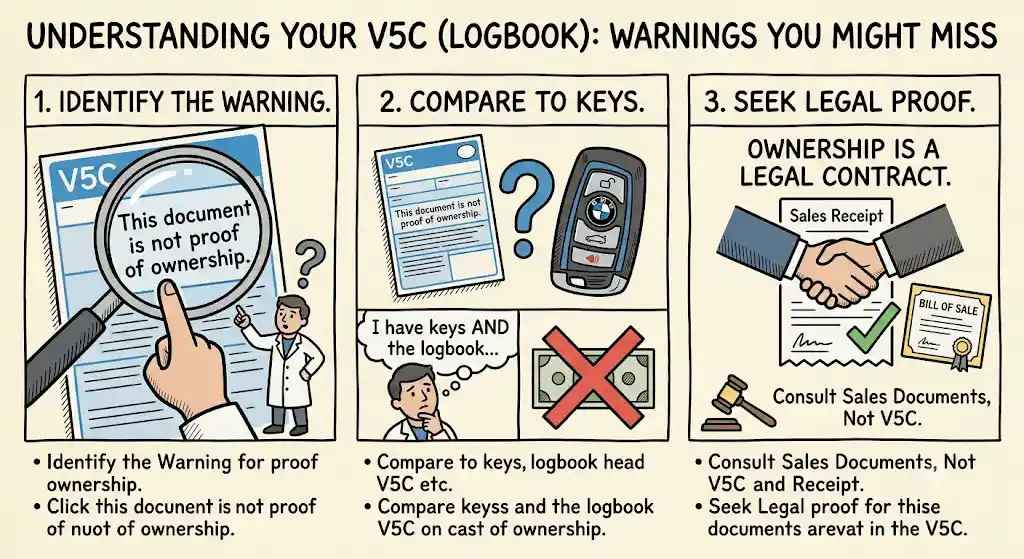
None of this makes the V5C useless — it makes it a verification tool rather than a title deed. Used properly at a viewing, it's one of the sharpest instruments you have:
Match the person to the paper
The keeper's name and address are printed on it. The person selling should be that person, at that address. Ask to see photo ID if it's a big-money sale — a genuine keeper won't mind.
Match the paper to the car
VIN, colour, engine size, plate — the V5C describes a specific vehicle. Check the VIN on the document against the VIN at the base of the windscreen and in the door frame. This single habit defeats clones, ringers and half the paperwork frauds in circulation.
Read its recent history
A V5C issue date from last month on a car "owned for years" needs explaining. So does a "new keeper" slip instead of the full document — that's sometimes innocent, and sometimes a car being flipped fast by someone who was never really its keeper.
Check the watermark and the serial
Real V5Cs carry a watermark. And blank certificates in specific serial ranges were stolen years ago and still surface on fraudulent sales — a full history check flags cars whose paperwork deserves a second look.
What actually proves ownership, then?
Boringly: the paper trail of the purchase. There is no single government-issued title document for cars in the UK — ownership is established by evidence. A proper receipt naming both parties, the date, the price, the registration and the VIN, signed by both of you. The bank transfer that matches it. The advert you responded to. The messages arranging the sale. Together, that stack is what a court — or a police officer untangling a dispute — actually looks at.
Write the receipt like it matters — because one day it might
Two copies, both signed: “Sold: [make, model, reg, VIN, mileage] by [seller name, address] to [buyer name, address] for [amount] on [date].” Pay by bank transfer, not untraceable cash, so the money leaves a matching footprint. Thirty seconds of admin that outranks the logbook in any argument about who owns what.
And the transfer itself has gone digital: the seller can transfer the keepership online at gov.uk in two minutes, you both get instant confirmation emails, and the tax sorts itself out (the seller gets the refund; you tax it fresh before driving home — road tax no longer transfers with the car). If the seller insists on “posting the green slip off later”, politely insist on watching the online transfer happen instead. It's free, it's instant, and it means nobody “forgets”.
The trap the V5C can't save you from
Even a perfect V5C, a matching VIN and a genuine seller at their own kitchen table can't tell you the one thing that voids the whole deal: whether the car is actually theirs to sell. Outstanding finance doesn't appear anywhere on the logbook. Neither does an insurance write-off, or a stolen marker filed an hour ago. The document that everyone treats as the car's birth certificate is silent on every question that costs buyers real money.
The two-minute companion to the logbook
That's what the history check is for. Run the plate through BuyCarCheck: the free check confirms the car's official identity, MOT and tax; the £4.99 full check answers the questions the V5C can't — outstanding finance, write-off history, stolen markers, and how many keepers the car has really had. V5C in one hand, history report in the other: that's the pair that actually protects you.
The whole thing, on a napkin
The V5C names the keeper, not the owner
It says so on the document. Finance companies, lease firms and theft victims can all out-rank the person holding it.
Use it as a verification tool
Match the person to the paper, the paper to the car (VIN!), and question a freshly issued V5C or a lone green slip.
Ownership is a paper trail, not a certificate
Signed receipt with reg + VIN, bank transfer, saved messages. Build the stack at every sale — buying or selling.
The logbook is silent on finance, write-offs and theft
Pair it with a history check before money moves. Two documents, two minutes, no nasty phone calls in three months.
The DVLA printed the warning on the document itself, which is about as loud as a government hint gets. “He had the logbook” has cost buyers millions of pounds and will cost millions more — just not, now, to you.
Found this useful?
A £4.99 check could save you thousands
Run a free basic check, or save money with a bundle — check three cars for just £11.99
Check before you buy
Finance · Write-off · Stolen · Keeper history