Buyer Guides
"Sold As Seen" Means Nothing (and Everything): Your Real Rights at Dealers, Driveways and Auctions
"Sold as seen, mate. No comebacks." It gets scrawled on receipts and muttered as money changes hands — and half the time it means absolutely nothing, while the other half it means everything. Which half you're in depends entirely on who sold you the car. Dealer, driveway or auction hall: here's what the phrase really does in each of the three worlds.

Ricki Angel
Founder, BuyCarCheck · 27 June 2026 · 8 min read
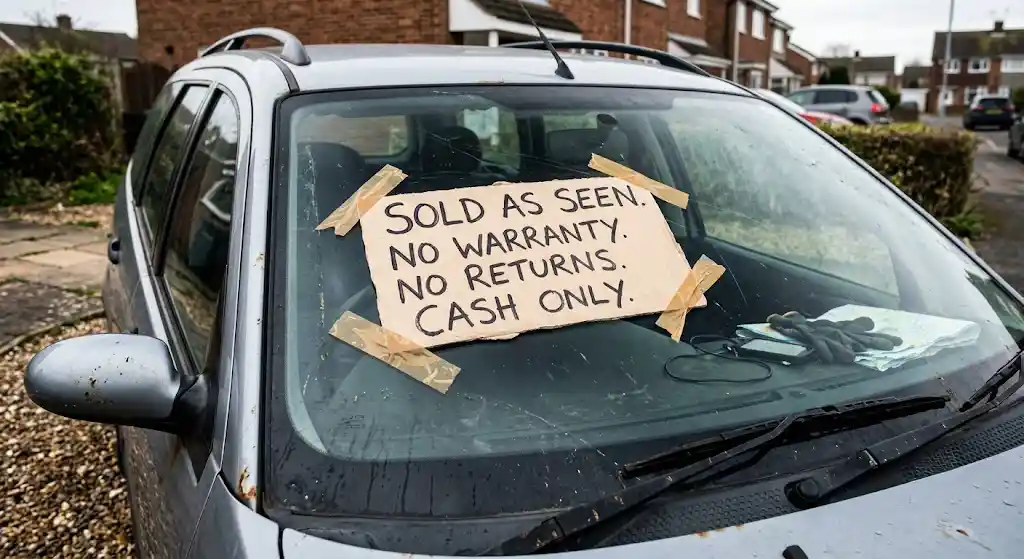
“Sold as seen, mate. No comebacks.” It gets scrawled on receipts, tacked onto adverts, and muttered at the exact moment money changes hands. It sounds official. It sounds final. It sounds like a legal force field around the seller.
Here's the thing: half the time it means absolutely nothing, and the other half it means everything — and which half you're in depends entirely on who you bought the car from. So I sat down and actually read the disclaimers — dealer small print, auction house terms, the lot — so you don't have to. This is what “sold as seen” really means at a dealer, on a driveway, and under the auctioneer's hammer.
Three sellers, three completely different rulebooks
English consumer law doesn't care what's written on the receipt. It cares about one question: was the seller acting as a business? Answer that, and everything else falls into place.
From a dealer: “sold as seen” is legally meaningless
When a business sells you a car, the Consumer Rights Act 2015 applies whether they like it or not. The car must be of satisfactory quality, fit for purpose, and as described. A trader cannot sign those rights away — not with a disclaimer, not with a “trade sale only” sticker, not with anything. Writing “sold as seen” on a trade invoice to a consumer isn't just ineffective, it can actually be an offence under consumer protection regulations.
Within 30 days of purchase you have a short-term right to reject a faulty car for a full refund. Up to six months, a fault is presumed to have been there at sale unless the dealer proves otherwise.
From a private seller: it's mostly true
Privately, the ancient rule of caveat emptor — buyer beware — really does apply. The car only has to be as described and the seller's to sell. If the head gasket lets go on the way home, that's your problem. The one thing “sold as seen” still can't do is launder a lie: if the advert said “never welded, full history” and neither is true, you can pursue them for misrepresentation. Descriptions bind; disclaimers don't erase them.
At auction: read the terms or get eaten by them
Physical auctions are the one place a business sale can lawfully strip back your consumer rights. The Consumer Rights Act allows traditional auctions — the kind you can attend in person — to exclude the usual protections, provided the terms say so and you had the chance to inspect. That's why auction cars are cheap. You are not a “consumer” in that hall; you're a bidder who agreed to the house rules the moment you registered a paddle.
Auction-speak, decoded
Auction catalogues have their own dialect, and every phrase is doing legal work. Here's the translation table:
"Sold as seen" / "As is, where is"
The purest form. No warranty of any kind. If it doesn't start on the ramp out, that's your recovery truck to arrange. Your inspection window — usually the few minutes it idles through the hall — was your entire opportunity.
"No major mechanical faults"
Sounds comforting. Read the definition: it usually covers only the engine, gearbox, transmission, brakes and steering, and only faults above a cost threshold — and you typically have to report them within an hour or so of the hammer falling. Electrics, air-con, clutch wear and anything cosmetic are excluded.
"On description" / "Sold with trial"
The auction house vouches for the description itself (mileage warranted, category history declared) — but only for the items listed, and only within the claim window. Miss the window, keep the car.
"Engineer's report available"
A condition report compiled by the auction house. Useful, but read the disclaimer on the report: it's "for guidance only" and almost never creates liability. It tells you what they noticed, not what exists.

The online auction wrinkle
Here's the twist most bidders don't know: the auction carve-out in the Consumer Rights Act applies to auctions you can attend in person. Buy from a trader through a purely online auction platform and, as a consumer, you may keep far more of your ordinary rights than the “sold as seen” theatre suggests. The platforms know this — it's why their terms are long, careful, and worth ten minutes of your life before you bid.
What no disclaimer can protect them from
Whatever the receipt says, three things survive every version of “sold as seen”:
Misrepresentation
A false statement that induced the sale — "never crashed", "genuine mileage", "no finance" — can unwind the deal at a dealer, on a driveway, or via an auction description. Screenshots of the advert are evidence. Take them before it's deleted.
The car must be theirs to sell
If there's outstanding finance, the finance company owns the car — not the seller, and not you, no matter what you paid or what the receipt says.
Roadworthiness
It's a criminal offence to sell a car in a dangerous, unroadworthy condition for use on the road — even privately, even "sold as seen" — unless it's explicitly sold for repair or parts.
The uncomfortable truth about all three routes
Notice what none of these rulebooks cover: the car's past. Rights or no rights, nobody at the rostrum, the forecourt or the driveway is obliged to volunteer that the car is a repaired Cat S, carries outstanding finance, or was reported stolen in Leeds. “Sold as seen” is only frightening when you haven't seen very much.
Make “as seen” mean something
Before you bid, transfer or shake hands, run the registration through BuyCarCheck. The free check pulls MOT history and tax status in thirty seconds; the £4.99 full check adds write-off, outstanding finance, stolen markers, keeper history and a CAP HPI valuation. At auction especially — where your legal safety net is thinnest — it's the only inspection nobody can rush you through.
On a napkin
Dealer + "sold as seen" = ignore it
Consumer Rights Act applies. A trader can't disclaim satisfactory quality, and pretending otherwise can itself be an offence.
Private + "sold as seen" = mostly real
Buyer beware — but descriptions still bind. Screenshot the advert before you view.
Auction = read the terms first
In-person auctions can lawfully exclude your usual rights. Know which sale category the lot is in before your arm moves.
Nothing disclaims history
Finance, write-offs and stolen markers pass every disclaimer untouched. Check the plate before money moves.
“Sold as seen” isn't a spell. It's a signpost telling you whose rulebook you're playing under — and the smartest thing you can do, under any of the three, is make sure you've genuinely seen the car's history before the gavel, the card machine or the envelope does its work.
Found this useful?
A £4.99 check could save you thousands
Run a free basic check, or save money with a bundle — check three cars for just £11.99
Check before you buy
Finance · Write-off · Stolen · Keeper history